

WEIGHTWORTH independently developed an anti-cheating system!
In the field of industrial weighing, the battle between cheating and anti-cheating has never ceased. From the initial methods of weighing scales and ranking, to later ones like remote control interference and license plate replacement, and now to highly covert ones such as sensor diaphragm digging and installing simulators, cheating methods have been constantly upgraded.
However, the passive defense methods of traditional truck scales - mechanical lead seals, ordinary cameras, and manual inspections - have long been inadequate.
As a professional truck scale manufacturer with sixteen years of industry experience, WEIGHTWORTH has independently developed a complete three-dimensional anti-cheating system, covering sensors, instruments, scale bodies and software platforms. This system can be adapted to all specifications of truck scales ranging from 10 tons to 300 tons, providing a reliable safety barrier for various industries such as mining, chemical engineering, grain depots, ports and metallurgy.

I. Overview of Weightworth's Anti-Cheating System
The Weightworth anti-cheating system is not a simple accumulation of single technologies, but rather a full-process control from "vehicle entry → weighing on the scale → data storage → factory verification". The whole is divided into three levels:
• Hardware layer: Digital sensor (anti-remote control), infrared grating (anti-pressure scale), high-definition camera (anti-license plate replacement/snapshot), shell opening detection (anti-disassembly), electronic lead seal.
• Software layer: Tare weight out-of-tolerance early warning, internal code anomaly analysis, hierarchical permission management, operation log auditing.
• Process layer: Automatic order matching, double-person confirmation (optional), integration with ERP, and prevention of duplicate weighing.
These three levels work in coordination to ensure that any cheating behavior is either immediately blocked or leaves behind non-repudiable electronic evidence.
II. Vehicle Entry and Weighing Process: No cheating vehicles are allowed to "board"
License plate recognition + order matching to plug the "license plate change" loophole
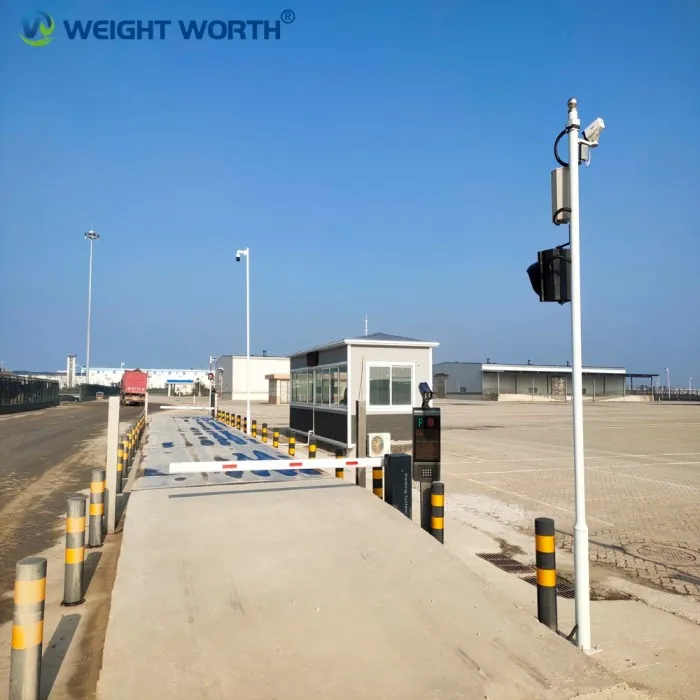
The Weightworth unmanned system is equipped with high-definition license plate recognition cameras at both access control and weighing stations. The system automatically compares the recognized license plate number with the dispatch order in the ERP/ order system. If the license plate number does not match the order (for example, the license plate of a large vehicle corresponds to the tare weight of a small vehicle), the system will refuse to weigh and issue an alarm. Meanwhile, the system supports vehicle face recognition (based on vehicle model, color, and brand features), making it difficult to confuse even when using similar license plates.
2. Infrared grating limit to prevent "weighing"
Many cheaters deliberately press the front or rear wheels of their vehicles against the edge of the scale platform, transferring some of the weight to the foundation, resulting in an underweight weighing. Weightworth installs infrared beam gratings at both ends of the scale platform. The system only allows weighing when the vehicle completely covers all the beams (i.e., is fully on the scale). If the vehicle is not fully positioned, the traffic light will show "No weighing", the instrument will not save the data, and the driver will be prompted by voice to adjust the position.
3. Multi-angle snapshots leave traces
After the vehicle is loaded onto the scale, the system automatically triggers two high-definition cameras at the front and rear to capture images: one for the front of the vehicle (including the license plate), and the other for the rear (including the cargo compartment and the goods). Photos and weighing records are permanently bound and stored locally or in the cloud. When conducting an audit in the future, the weight slip can be retrieved to see the vehicle's status at that time, and it cannot be denied.


III. During the weighing process: Make the sensor "immune" to remote control
1. Digital sensors - The Nemesis of remote controls
Traditional analog sensors output millivolt-level voltage signals. Cheaters only need to parallel a voltage generator (remote control receiving board) to the signal line to change the instrument readings at will. The entire series of Weightworth adopts digital sensors, and the output is an encrypted RS485 digital signal. The instrument and the sensor communicate through a private protocol, and each frame of data is equipped with dynamic verification. The remote control cannot simulate legal digital signals. Even if it is forcibly connected to the line, the instrument will refuse to receive and alarm due to protocol mismatch.
2. Sensor shell opening detection and electronic lead seal (anti-digging diaphragm)
For high-end cheating - by opening the sensor housing and installing a remote control chip inside, Weightworth offers two layers of protection. The first layer: The sensor is fully welded and sealed, with inert gas filled inside. Once the housing is damaged, the pressure change is immediately detected and the instrument alarms. The second layer: Electronic lead seal - Each sensor has a unique digital ID. The instrument only trusts the registered ID, and the communication key is updated regularly. Even if the cheater successfully replaces the sensor, it won't work without a matching ID. For detailed principles, please refer to the previous article of this series, "In-depth Analysis of Anti-Digging Diaphragm Cheating Technology".
3. Self-diagnosis of instrument abnormalities
Weightworth instruments continuously monitor the internal code values, communication status and excitation voltage of each sensor. If a sensor suddenly disconnects, its internal code jumps sharply or remains unresponsive for a long time, the instrument will display the specific fault code on the screen (such as "Communication failure of Sensor No. 3"), and simultaneously push it to the administrator via email or text message. This real-time self-diagnostic capability ensures that cheaters have no "incubation period".
VI. Customer Value and Input-Output Ratio
After deploying the Weightworth anti-cheating system, enterprises can achieve immediate results:
• Direct loss control: Multiple clients have reported that the system avoided losses ranging from hundreds of thousands to millions of yuan in the first year of its launch due to cheating.
• Management efficiency improvement: Automatic snapshot capture, automatic alarm, and automatic generation of suspicion records eliminate the great effort of manual inspection and post-event investigation.
• Compliance Assurance: Meet the requirements of ISO 9001, GMP and other systems for the integrity of measurement data, and enhance credibility in trade settlement.
VII. Conclusion
Cheating and anti-cheating are an asymmetrical confrontation - the cheater only needs to find one loophole, while the defender has to block all possible paths.
With sixteen years of technological accumulation and an in-depth understanding of cheating methods in various industries, Weightworth has independently developed this three-dimensional anti-cheating system that covers the entire process and is compatible with all specifications. It is not a patchwork of several functions, but it is a mature solution that has been verified by thousands of projects.
For any enterprise that hopes to achieve cost reduction and efficiency improvement through unmanned weighing, choosing Weightworth means choosing a reliable partner that can continuously combat the threat of cheating. Make sure every ton of material is weighed precisely and every transaction stands up to scrutiny.


