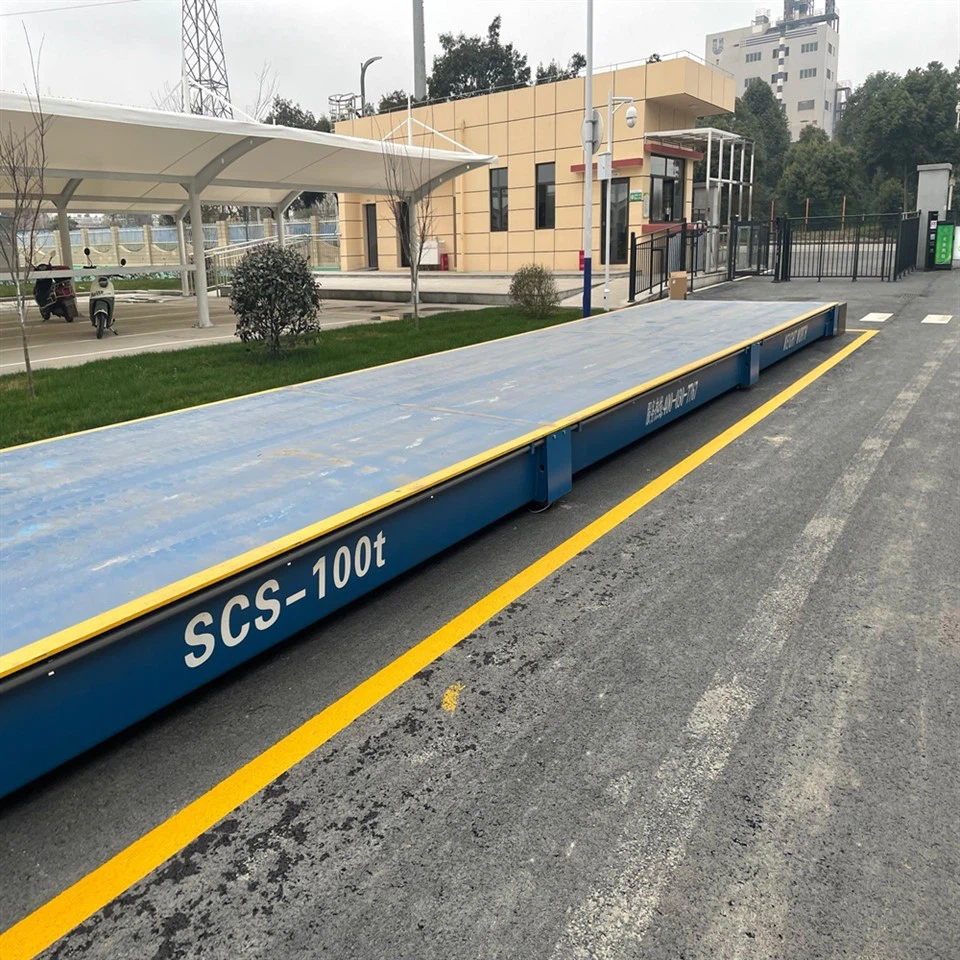
As a supplier of Carbon Steel Floor Scales, I've had the privilege of witnessing firsthand the critical role that load cells play in the functionality and reliability of these essential weighing devices. Load cells are the heart of any floor scale, converting the force exerted by the weight of an object into an electrical signal that can be measured and displayed. In this blog post, I'll delve into the different types of load cells commonly used in carbon steel floor scales, exploring their unique characteristics, advantages, and applications.
Strain Gauge Load Cells
Strain gauge load cells are by far the most widely used type of load cell in carbon steel floor scales. These load cells operate on the principle of strain, which is the deformation of a material under stress. When a weight is placed on a floor scale equipped with strain gauge load cells, the load cells experience a mechanical deformation, causing the strain gauges attached to them to change their electrical resistance. This change in resistance is proportional to the applied force, allowing the scale to accurately measure the weight of the object.
One of the key advantages of strain gauge load cells is their high accuracy and reliability. They are capable of providing precise weight measurements with a high degree of repeatability, making them ideal for applications where accuracy is paramount. Additionally, strain gauge load cells are relatively inexpensive compared to other types of load cells, making them a cost-effective choice for many users.
Another advantage of strain gauge load cells is their versatility. They can be designed to handle a wide range of capacities, from a few kilograms to several tons, making them suitable for a variety of applications. Strain gauge load cells are also available in different configurations, including single-point, beam, and shear beam load cells, each of which is optimized for specific applications.
Single-point load cells are typically used in small to medium-sized floor scales, where the weight is evenly distributed over the weighing platform. These load cells are compact and easy to install, making them a popular choice for applications such as retail weighing, laboratory weighing, and small industrial weighing.
Beam load cells, on the other hand, are designed to handle larger capacities and are commonly used in medium to large-sized floor scales. These load cells are available in different shapes and sizes, including rectangular, circular, and S-shaped beams, and can be configured to measure weight in either tension or compression.
Shear beam load cells are a type of beam load cell that is specifically designed to measure the shear force applied to the load cell. These load cells are commonly used in applications where the weight is not evenly distributed over the weighing platform, such as in forklift scales and truck scales. Shear beam load cells are highly accurate and reliable, and they are capable of providing precise weight measurements even in harsh environments.
Hydraulic Load Cells
Hydraulic load cells are another type of load cell that is commonly used in carbon steel floor scales. These load cells operate on the principle of fluid pressure, where the weight of an object is applied to a piston that is immersed in a hydraulic fluid. The pressure exerted by the piston on the hydraulic fluid is proportional to the applied force, allowing the scale to accurately measure the weight of the object.
One of the key advantages of hydraulic load cells is their high capacity. They are capable of handling very large weights, making them suitable for applications such as heavy industrial weighing, truck weighing, and railway weighing. Hydraulic load cells are also highly reliable and durable, and they are capable of providing accurate weight measurements even in harsh environments.
Another advantage of hydraulic load cells is their immunity to electrical interference. Unlike strain gauge load cells, which are sensitive to electrical noise and interference, hydraulic load cells are not affected by electrical signals, making them ideal for use in environments where electrical interference is a concern.
However, hydraulic load cells also have some disadvantages. They are relatively expensive compared to strain gauge load cells, and they require regular maintenance to ensure their proper operation. Additionally, hydraulic load cells are not as accurate as strain gauge load cells, and they are typically used in applications where a high degree of accuracy is not required.
Pneumatic Load Cells
Pneumatic load cells are a type of load cell that operates on the principle of air pressure. These load cells consist of a diaphragm that is connected to a pressure sensor. When a weight is placed on the weighing platform, the diaphragm is deformed, causing the air pressure inside the load cell to change. This change in air pressure is proportional to the applied force, allowing the scale to accurately measure the weight of the object.
One of the key advantages of pneumatic load cells is their high accuracy and reliability. They are capable of providing precise weight measurements with a high degree of repeatability, making them ideal for applications where accuracy is paramount. Additionally, pneumatic load cells are relatively inexpensive compared to other types of load cells, making them a cost-effective choice for many users.
Another advantage of pneumatic load cells is their immunity to electrical interference. Unlike strain gauge load cells, which are sensitive to electrical noise and interference, pneumatic load cells are not affected by electrical signals, making them ideal for use in environments where electrical interference is a concern.
However, pneumatic load cells also have some disadvantages. They are relatively slow to respond compared to strain gauge load cells, and they are not suitable for applications where high-speed weighing is required. Additionally, pneumatic load cells are sensitive to changes in temperature and humidity, which can affect their accuracy.
Choosing the Right Load Cell for Your Carbon Steel Floor Scale
When choosing a load cell for your carbon steel floor scale, there are several factors to consider, including the capacity, accuracy, reliability, and cost of the load cell. You should also consider the environment in which the scale will be used, as some load cells are more suitable for harsh environments than others.

If you require a high degree of accuracy and reliability, strain gauge load cells are typically the best choice. These load cells are available in a wide range of capacities and configurations, and they are capable of providing precise weight measurements with a high degree of repeatability.
If you require a high-capacity load cell for heavy industrial weighing applications, hydraulic load cells may be the best choice. These load cells are capable of handling very large weights, and they are highly reliable and durable.
If you require a load cell that is immune to electrical interference and is suitable for use in environments where electrical noise is a concern, pneumatic load cells may be the best choice. These load cells are relatively inexpensive and are capable of providing accurate weight measurements with a high degree of repeatability.
In addition to the type of load cell, you should also consider the features and options available on the floor scale. For example, some floor scales come with built-in indicators, while others require an external indicator to display the weight. You should also consider the size and shape of the weighing platform, as well as the type of construction and finish of the scale.

At our company, we offer a wide range of Carbon Steel Floor Scales, including Stainless Steel Floor Scales, Floor Scales with Pit Frames, and Low Profile Floor Scales. Our scales are equipped with high-quality load cells that are designed to provide accurate and reliable weight measurements in a variety of applications.
If you're in the market for a Carbon Steel Floor Scale, we invite you to contact us to discuss your specific requirements. Our team of experts will be happy to help you choose the right scale and load cell for your needs, and we'll work with you to ensure that you get the best possible value for your investment. Whether you're looking for a small, portable scale for your laboratory or a large, heavy-duty scale for your industrial facility, we have the solution for you. Contact us today to start the conversation and take the first step towards improving your weighing operations.
References
- Ono, M., & Yamada, T. (2003). Load cell technology and its applications. Sensors and Actuators A: Physical, 107(1-2), 1-11.
- Doebelin, E. O., & Nise, N. S. (2015). Measurement systems: Application and design. McGraw-Hill Education.
- ISO 376:2011. Metallic materials - Calibration of force-proving instruments used for the verification of uniaxial testing machines.