



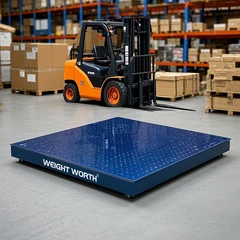

The working principle of industrial electronic scales is mainly based on Hooke's law and the principle of lever balance of force. The weight of the object is converted into an electrical signal through the sensor, and after amplification, analog-to-digital conversion and other processing, the weight data is finally displayed on the display.
Working principle
Pressure sensing: When an object is placed on the scale pan, the weight of the object is applied to the sensor, and the sensor undergoes elastic deformation, thereby changing its impedance and excitation voltage, and outputting a changing analog signal.
Signal conversion: After the analog signal is amplified by the amplifier circuit, it is sent to the analog-to-digital converter (A/D converter) and converted into a digital signal that is easy to process.
Data processing: The digital signal is sent to the central processing unit (CPU), and the CPU performs calculations according to keyboard commands and programs, and finally displays the results on the display.


