


Throughout the long course of industrial civilization, measurement has always been the cornerstone of fair trade. From the unification of weights and measures by the Qin Dynasty to the establishment of the modern international System of units, humanity's pursuit of precision has never ceased. In today's industrial production sites, every time a vehicle passes over a weighbridge, it is a testament to trust and fairness.
Qingdao Weightworth Automation Equipment Co., Ltd. is precisely the modern interpreter of this ancient proposition. Taking the unmanned weighing system and Weightworth truck scales as the core, we have shifted measurement from "experience-based judgment" to "data-driven decision-making", safeguarding fairness for every transaction and building trust for every enterprise.
The essence of measurement: Fairness is the starting point of all transactions
In business activities, fairness is the fundamental logic of transactions. When a truckload of ore is transported from a mine to a smelting plant, when a granary of grain is transferred from a farmer's hands to a grain depot, and when a batch of finished products is sent from a factory to a customer, the numbers on the scale determine the transaction amount, cost and profit. The accuracy of this figure directly affects the vital interests of both buyers and sellers, as well as the stability and harmony of the supply chain.

However, the limitations of traditional manual measurement often pose challenges to fairness:
The human factor is hard to eliminate. The fatigue, distraction and emotional fluctuations of the weighers can all affect the accuracy of the records. A momentary daze during a late-night shift may lead to a measurement deviation in a transaction. Not to mention, the human intervention of a very small number of people has directly undermined the principle of fairness.
Environmental factors are difficult to control. Dust, moisture, temperature differences and electromagnetic interference can all affect the measurement accuracy of traditional floor scales. Weighing the same vehicle at different times and in different environments may yield different results, triggering endless disputes.
It is difficult to establish a traceability mechanism. When disputes arise, it is often difficult to restore the scene with just a paper document. Was it that the vehicle wasn't fully loaded onto the scale? Was there a clerical error when taking notes? Or for some other reason? The truth is often buried in the dust of time.
These problems, in essence, all erode fairness. The mission of Vitworth is to ensure that every measurement can stand up to scrutiny through technological innovation.
The cornerstone of precision: The hardcore strength of Vitworth truck scales
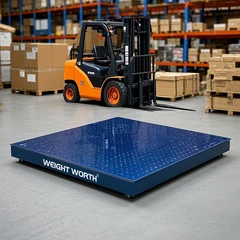
To achieve fairness, reliable hardware support is first needed. Vitworth truck scales adopt high-precision digital sensors and modular steel structure design, raising the measurement accuracy to a new level.
The core advantage of digital sensors lies in the purity of signal transmission. Traditional analog signals are prone to temperature, humidity and electromagnetic interference during transmission, and signal attenuation and drift are inevitable. The digital sensors of Vitworth directly output digital signals, with their anti-interference capability enhanced by over 80%. Even in the harshest industrial environments, they can maintain a long-term stability of ±0.1%.
What does this level of precision mean? For an enterprise with an annual throughput of one million tons, it is equivalent to reducing several hundred tons of measurement errors each year. For the non-ferrous metals industry, which is worth several thousand yuan per ton, it means recovering potential losses of several million yuan every year. More importantly, it enables upstream and downstream partners to have a clear understanding of every transaction without the need for repeated verification or doubt.
Modular design also reflects the pursuit of fairness. The scale body adopts standard modules, which can be flexibly combined according to on-site requirements. This not only ensures the stability of the structure but also facilitates later maintenance and calibration. When a certain module needs maintenance, it does not affect the overall operation and ensures the continuity of the measurement work.


Impartial Protection: Triple Assurance of Unattended Weighing System
If the truck scale is the "hardware foundation" of fairness, then the unmanned weighing system is the "software guarantee" of justice. It safeguards every transaction with a triple mechanism.
The first level: Contactless recognition, eliminating identity fraud
The system integrates multiple technologies such as license plate recognition, RFID radio frequency, and electronic tags, completing identity verification the moment a vehicle enters. The system automatically retrieves the order information and verifies whether the type of goods and the transportation task match. This process requires no human intervention and completely eliminates the possibility of vehicle identity being misused. At a grain depot in Henan Province, the system successfully intercepted a vehicle that attempted to use someone else's license plate for repeated weighing, thus avoiding losses of tens of thousands of yuan.
The second level: AI vision, ensuring compliance on the scale
The system monitors the vehicle's position in real time through infrared positioning and AI visual analysis. When the vehicle is not fully loaded onto the scale, pressed against the edge, or does not come to a complete stop, the system will automatically issue a voice prompt and will not start the measurement until the vehicle is adjusted to the correct position. This kind of "rigid" insistence is precisely the greatest guarantee of fairness - every measurement is completed under exactly the same standard, with no "special circumstances".
The third level: Full documentation throughout the process to make the truth traceable
The system automatically links multi-angle high-definition cameras to record the entire weighing process. Weight data, license plate information, timestamps, and on-site images are bound in real time to generate an encrypted electronic evidence chain. When disputes arise, managers can retrieve the scene at that time with one click, restoring the scene - whether the vehicle is compliant, if there are any abnormalities, and whether the data is accurate are all clear at a glance. This dual recording of "data + images" enables any doubts to be answered within minutes.
The Value of Trust: From "Reducing Disputes" to "Enhancing Competitiveness"
When precise measurement becomes the norm and fair trade becomes a consensus, what enterprises gain is not only a reduction in disputes but also an overall enhancement of commercial value.
Reduce transaction costs. There is no need to conduct cumbersome verifications at each settlement, significantly enhancing financial efficiency. A certain steel enterprise reported that after the system was launched, the monthly reconciliation time was shortened from one week to half a day. The financial staff were liberated from the fatigue of verification and turned to more valuable analysis work. The trust level of suppliers in their accounts has increased, and the payment cycle has also been shortened accordingly.
Enhance partner stickiness. Suppliers and customers are more willing to cooperate for a long time because of transparent and fair measurement. The person in charge of a certain grain depot said, "Farmers are now willing to sell their grains to us because our scales are the 'most fair'." Some farmers would rather drive tens of kilometers more than come here to sell their grain. This word-of-mouth effect becomes an intangible competitive advantage for enterprises.
Enhance the industry's reputation. Establish a trustworthy image within the industry and attract more high-quality partners. Measurement fairness has become a "credit business card" for enterprises and plays a subtle role in bidding and tendering as well as business negotiations. An enterprise that was selected into the system and awarded the title of "Honest Measurement Demonstration Unit" in the local area admitted, "This title is more effective than any advertisement."
Witness: How Does Fairness Transform the Business Ecosystem
In a copper mine in Jiangxi Province, the introduction of the Vitworth system has completely transformed the cooperative relationship with the transportation company. Previously, disputes over measurement occurred more than 20 times a month, and sometimes even affected normal production. After the system was launched, disputes dropped to almost zero, and the transportation company voluntarily requested to renew the long-term contract. The mine manager sighed, "In the past, it was like 'fighting on the scale and quarrelling on the table', but now everyone trusts the data and cooperation is much smoother."
At a certain grain reserve depot in Shandong Province, the changes during the peak period of summer grain purchase are equally significant. Under the traditional model, farmers have to wait in line for a long time, there are many disputes over measurement, and they sell grain.

Conclusion
In the business world, fairness is the most precious asset and also the scarcest resource. Every precise measurement is a safeguard of fairness. Every transparent transaction is an accumulation of trust.
Qingdao Vitworth Automation Equipment Co., LTD., with unmanned weighing systems and Vitworth truck scales as its fulcrum, is helping more enterprises lay a solid foundation for fairness. We believe that when every weighing can stand the test and every transaction is based on reliable data, the business ecosystem of enterprises will be healthier, more efficient and more sustainable.
Fairness is not just a slogan, but an accumulation based on every precise measurement. Vitworth is willing to work with you to safeguard this precious business asset and make every transaction a testament to trust.


